Specialist AI, sooner: Luminance’s approach to AI enablement
Mael Jullien and the Luminance R&D/AI/Agents Team
Businesses already have the expertise AI needs to work effectively, but it’s often dispersed across systems, documents, and people’s heads.
Generative AI is now powerful enough to transform how work gets done. Yet its capabilities cannot deliver meaningful results when they’re disconnected from the knowledge and processes that shape how a business operates. The knowledge exists. The AI exists. The two are not yet meeting.
Contract Intelligence is the solution, but it doesn’t come for free. To be effective, the intelligence needs to be tuned to an organisation – it needs to learn the contractual knowledge, standards, context, and processes. That tuning and configuration can be laborious. In this article, we show how Luminance uses AI agents to achieve this intelligence and enable it for teams across the enterprise.
Why context matters
For legal teams and their commercial colleagues, that difference becomes concrete when AI can apply an organization’s negotiation playbook, use its approved wording, and work within its established approval process.
Much of this knowledge has traditionally lived in experienced lawyers’ minds. Capturing it as context allows others to draw on that expertise with the same guidance and institutional knowledge, without requiring the lawyer to explain each position or oversee every routine decision.
This is more than a productivity gain; it creates a new organizational capability: expertise that once depended on one person’s availability can now support work across the enterprise.
Specialist AI performs better with specialist context
Research increasingly shows that AI performance depends on how workflows and tools are configured around a task.
Studies including AFlow and OctoTools demonstrate improvements across benchmarks across many domains, including mathematics, coding, and medical question answering. Similarly, General AgentBench found that most evaluated agents experienced average relative performance drops of 10–30% when moving from specialized configurations into a general environment with shared toolsets.
Together, these findings suggest that task-specific workflows and tools can improve performance far beyond what a general-purpose model delivers out of the box. For teams across the enterprise, the corresponding opportunity is to combine those capabilities with organizational context: preferred drafting positions, risk appetite, approval thresholds, and previous decisions.
That context helps AI move beyond retrieving information to applying established business standards, and, as approved decisions and experience accumulate, provides a foundation for increasing value over time.
The value of organizational knowledge compounds
Configuring and integrating an organization’s knowledge into an AI platform is an investment.
As relevant context, approved decisions, corrections, and successful procedures accumulate, the platform can draw on that experience to produce higher-quality, more consistent work and more relevant answers. Persistent memory reduces the need for teams to explain the same context repeatedly, while providing a foundation for refining established workflows.
With effective orchestration, this accumulated knowledge, workflow guidance, and guardrails can be carried forward as newer frontier models are introduced. Improvements in model capability can therefore build on the organization’s existing investment in the AI application and surrounding platform.
This creates cumulative value and platform stickiness: the platform becomes increasingly useful as its organizational context deepens, while the organization gains a more consistent way to apply its expertise. Yet, establishing that foundation has traditionally required substantial upfront effort.
The challenge of getting AI into production
In a 2025 Corinium Intelligence and ModelOp survey of 100 senior enterprise leaders, 56% reported that generative AI initiatives took six to eighteen months to move from intake to production.
That is a significant gap between identifying an opportunity and putting it to work. It means organizations can invest in AI, understand its potential, and still wait months before employees can benefit.
Legal teams faced a particularly difficult version of that challenge. Negotiation guidance was spread across spreadsheets and documents. Templates contained years of drafting decisions, with instructions in comments and alternative clauses for different circumstances. Approval processes depended on knowledge distributed across legal and commercial teams.
Bringing these into a new platform required people to interpret the material, configure the rules, and check that everything behaved as intended.
Much of that work fell to the same specialists whose time the software was intended to save. As a result, legal teams had to invest substantial time in translating their organization’s knowledge and processes into system requirements before AI could apply that expertise effectively.
How Luminance brings onboarding into the AI workflow
At Luminance, we believe AI should help with the work of enablement and onboarding, too.
Our platform makes legal knowledge actionable across the enterprise, helping teams negotiate consistently, identify risk, and make informed commercial decisions.
To help customers realize those benefits sooner, we have developed, and are continuing to develop, specialized onboarding agents to help customers bring their existing legal knowledge into our ecosystem, reducing the manual work involved in configuring the platform around their needs.
Turning agreements into reusable templates
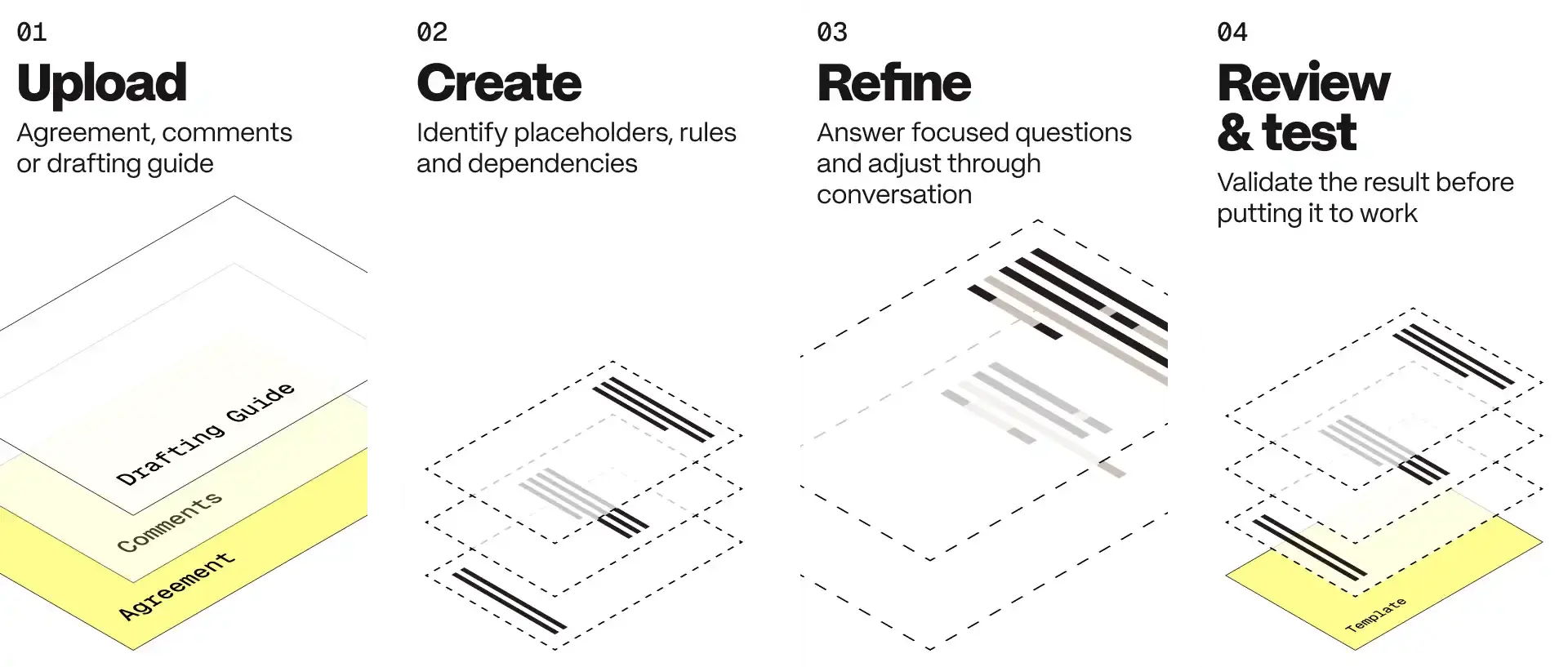
Our Template Agent shows what this looks like in practice. Upload an existing agreement, and Lumi helps turn it into a reusable template your team needs to generate contracts. Users can refine the drafting rules through conversation, review and approve the results, and put it to work.
This has turned weeks of arduous manual templating into minutes with Lumi, Luminance’s AI-powered assistant. Working from drafting instructions in the document, comments, or a separate guide, Lumi can create new templates, update existing ones, and turn executed agreements into reusable templates. It can also handle documents containing multiple languages.
Even a 100-page document with hundreds of placeholders and decision branches can be templated in under ten minutes.
Trained and validated on hundreds of expert-annotated templates, the Template Agent combines semantic task routing, dynamic skill selection, and specialist AI subagents to choose the right approach for each document.
Working with Lumi, it takes a comprehensive first pass, planning what should be templated and how, identifying dependencies, and highlighting decisions that require the user’s intent.
In internal testing, the agent achieves over 90% accuracy after a single user interaction. It then refines the template through quick iterations, asking focused questions with suggested options or acting on the user’s instructions. Automated validation identifies and corrects issues, bringing the template in line with the user’s requirements.
Turning negotiation guidance into actionable playbooks. Our Playbook Agent extends this approach to creating, querying, and updating negotiation playbooks through conversation.
Users can provide templates and playbook materials in their existing internal formats. Lumi will clarify ambiguities with the user and convert this semi-structured guidance into consistent negotiating positions for the Negotiation Agent to apply when reviewing and marking up contracts.
As an organization’s standards evolve, users can update their playbooks through the same conversation, giving legal teams greater control over how AI applies their guidance, while enabling commercial colleagues to draw on approved negotiating positions without requiring a lawyer’s involvement in every routine decision.
Putting organizational knowledge to work, sooner
Specialized AI can put an organization’s expertise to work across the business, but realizing that value has often required a lot of upfront effort. Historically, teams have had to spend time translating templates, negotiating standards and approval processes into configurations, with much of the work falling to the specialists whose time the technology is intended to save.
Luminance is changing this by making AI part of the enablement process itself.
From the Template Agent to Playbook Agent, Lumi is helping customers turn existing guidance and institutional knowledge into negotiating positions and workflows through conversation.
For our customers, this means a shorter path from adopting AI to benefiting from it. Legal teams can spend only a little time configuring our product – no more than they would want to spend anyway to gain the trust they need, while colleagues across the business gain access to approved guidance for routine decisions. As standards evolve and experience accumulates, that foundation can continue to grow, allowing advances in AI capability to build on the knowledge customers have already invested in the platform.
Discover how Luminance can help your business.
© 2026 Luminance. All rights reserved.