Billion-dollar blind spot: the untapped value of Contract Intelligence across global enterprises
introduction
The Contract Intelligence gap is not possession. It is use.
Businesses already hold much of the contract intelligence they need to manage risk, protect revenue and capture commercial value. The commitments, obligations, pricing, renewals, concessions and decisions that shape how a business operates are contained inside their contracts.
The challenge is not simply storing or preserving contracts. It is making the intelligence they already contain accessible and actionable across the enterprise.
However, too often, contractual knowledge is fragmented across systems, emails and individuals. This means teams cannot retrieve, understand and act on that intelligence when they need it and what begins as an individual productivity problem can quickly become an enterprise intelligence problem.
The cost is significant. When commercial intelligence is fragmented across documents, systems, emails, and people’s heads, teams act without the complete context they need - leading to missed savings, delayed decisions, unmanaged obligations, avoidable risk, and commercial value left on the table.
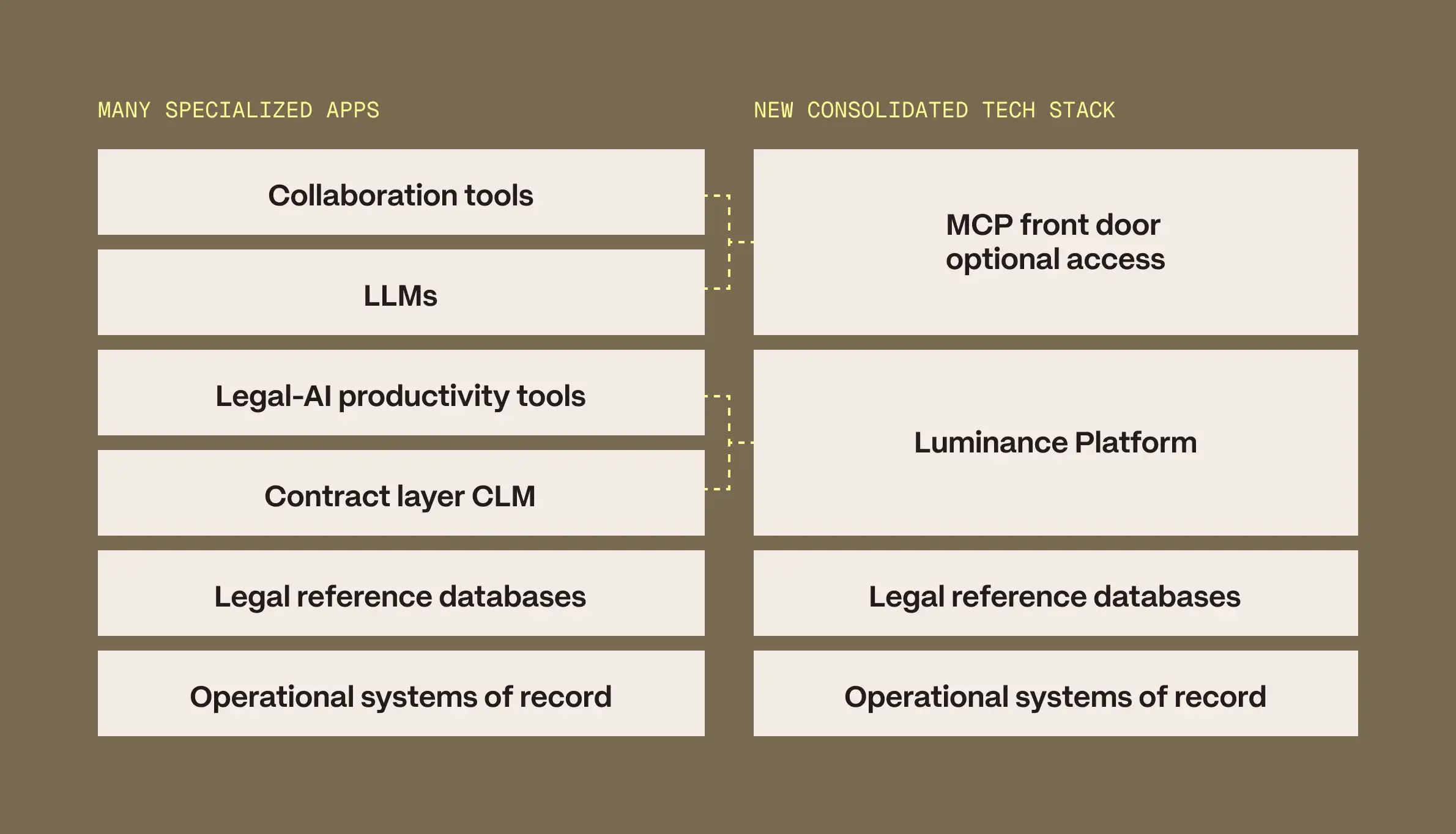
THE STATE OF CONTRACT INTELLIGENCE
What this research sets out to understand
Until now, much of the promise of AI has been about speed: finding information, returning answers, and helping people complete individual tasks faster. That is useful, but it only addresses the first question: what information can we retrieve? The more important question is what happens next. Can AI understand the context behind that information, connect it to what came before, reason through complexity, and help people decide and act?
This marks a shift from AI as a faster way to find answers to AI as intelligence embedded in how work gets done. The destination is not another chatbot or point solution, but connected intelligence within the fabric of the organization that learns from the enterprise and helps it move with greater clarity and confidence.
Based on a global survey of 538 General Counsels, Heads of Legal Operations, CCOs, Procurement Leaders, CFOs and COOs, this report on the state of contract intelligence examines:
Lack of Access: How readily enterprises can access the commercial knowledge and context held within their contracts
Lack of Access: Where that knowledge resides today – and the cost of it remaining fragmented
Missed Opportunity & Increased Risk: How effectively organizations can understand their entire contract portfolio when external circumstances change
Missed Opportunity & Increased Risk: Whether gaps in contractual intelligence are already translating into risk, missed opportunity and poorer decisions
From contract storage to contract intelligence
THE STATE OF CONTRACT INTELLIGENCE
Key Findings
31% say this much annual contract value has reasoning held solely by individuals, emails or personal files
33% must speak to legal or the contract owner to get information they need.
Only a fifth can immediately access why contract terms were agreed
31% struggle significantly to locate or explain commercial contract details
1 in 3 people have missed or delayed a commercial decision because contract information wasn’t accessible
CHAPTER 04
The cost of fragmented contract knowledge
Only one in five can immediately access
why terms were agreed.
The problem begins with where contract information is stored.
Legal teams have spent the past decade digitizing contracts and investing in CLM systems to bring greater structure to how agreements are stored and managed. Yet digitization has not solved the intelligence problem, as a quarter (24%) of respondents reported their organization currently stores key information in email or personal files, while 30% hold contracts across multiple systems.
It’s therefore unsurprising that 79% of respondents cannot reliably reconstruct why their own terms were agreed.
When trying to find that context, respondents said they either had to search manually (20%), ask the contract owner (18%) or ask Legal (15%). Almost two in five respondents – 37% – say their organization’s critical contract knowledge depends on the specific people who “happen to know about it.”
This creates more than a storage problem. It makes contractual knowledge difficult to retrieve, vulnerable to being lost and dependent on individual memory rather than a shared source of intelligence. For the wider business, it means dependence on individuals rather than a shared source of intelligence – increasing the risk that obligations are missed, rebates and savings go unclaimed, renewals stall and commercial decisions are made without the full picture.
The impact is particularly visible among senior leaders. CCOs report the highest levels of fragmentation: 39% hold contracts across multiple systems and 36% need to conduct a manual search to find a single term, despite 45% saying they have a platform. Among General Counsel, 46% say the reasoning behind a negotiation sits elsewhere or cannot be found.
For commercial leaders, this can mean slower deals, weaker negotiating positions and missed opportunities. For General Counsel, it means carrying responsibility for contractual risk while the reasoning and precedent behind decisions remain difficult to retrieve. For the wider business, it means dependence on individuals rather than access to a shared source of intelligence resulting in missed terms, rebates in payments, and missed commercial opportunity.
From fragmented knowledge to enterprise access
Only 23% of respondents say their organization currently uses AI search or Contract Intelligence tools. The opportunity is to make contractual knowledge accessible beyond Legal and the contract owner – so teams can retrieve trusted information, understand it in context and act without unnecessary delay.
Eleanor Lightbody
CEO, Luminance
“When the reasoning behind billion-pound contract portfolios lives in inboxes or individual memory, that intelligence cannot compound. As access to powerful AI becomes widespread, differentiation will come from what an organization knows: its data, history, workflows and the thousands of decisions it has made over time.”
CHAPTER 05
The billion-dollar blind spot
How fragmented knowledge puts contract value at risk
The consequences of fragmented contract intelligence aren’t limited to inefficiency. When the reasoning behind billion-dollar contracts is scattered across personal files, emails, and individual memory, businesses face poorer decisions, greater risk and missed commercial opportunity. As a result, institutional memory becomes an enterprise risk when billions in contractual value depend on it.
Our research revealed that for 31% of respondents, more than £1 billion in annual contract value is associated with contracts where the reasoning sits solely with individuals, in emails or in personal files. One in ten put that figure above £5 billion.
General Counsel report the greatest concentration of this exposure: 63% say more than £1 billion in annual contract value is associated with contracts where the reasoning is difficult to access. At the same time, 12% report no exposure at all.
This sharp divide may point to very different levels of visibility across Legal teams. Some may be beginning to consolidate and analyze their contract portfolios, while others may lack the access needed to identify where critical knowledge and value reside.
CHAPTER 06
When the world changes, can your contracts answer back?
The tariff test
Fragmented contract knowledge creates internal problems that organizations can address: inefficiency, duplicated work, Legal bottlenecks and commercial value left unaccounted for.
But what happens when an event outside the business changes the meaning, cost or risk of the commitments held within its contracts?
Tariffs change. Interest rates move. Regulations shift. Suppliers fail. Markets are disrupted.
The questions left to organizations are no longer simply where the contracts are stored or how can you access the intelligence when you need it. The questions are whether the business can quickly determine which agreements are affected, what the exposure is and what action should follow.
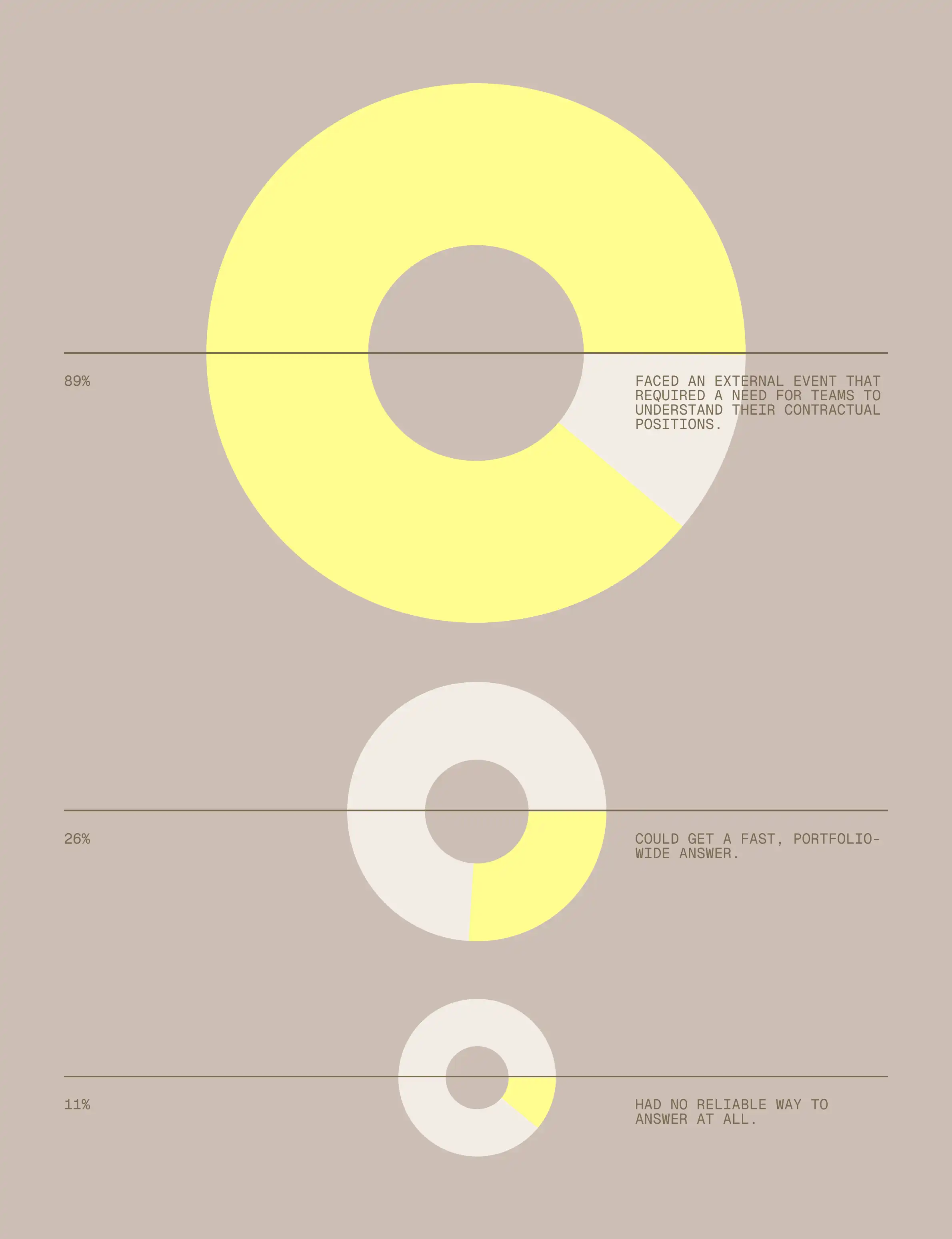
The risk isn’t theoretical. Our research revealed a staggering 89% of respondents faced an external event – such as a new tariff change, regulatory shift, or a movement in interest rates – that required a need for teams to understand their contractual positions. Yet only a quarter (26%) could get a fast, portfolio-wide answer and 11% had no reliable way to answer at all.
This suggests that the need to understand how external events affect contracts is now a regular enterprise requirement, not an occasional legal exercise.
This creates a serious gap between the speed of external change and the organization’s ability to respond. Businesses may know that an event matters but still lack a reliable way to identify the affected agreements, quantify the exposure, understand which provisions apply and coordinate the next action.
Tomorrow, a new tariff comes into force.
A business will ask, “Which contracts are affected? What is the financial exposure? Which provisions apply? What action is required?”
For 53% of respondents, answering those questions across the portfolio requires manual work across multiple teams. A further 26% depend on specific individuals or have no reliable way to understand the impact.
That means a time-sensitive commercial question becomes a cross-functional investigation. Teams must search across contracts and systems, ask the people who may know where the relevant information sits, and manually piece together an answer.
By the time the business has established what changed and which agreements are affected, the opportunity to respond may have narrowed – or the cost may already be embedded in the business.

From external shock to coordinated action
CHAPTER 07
One gap. Multiple consequences.
The tariff test shows what happens when external change demands an answer. But the cost of the Contract Intelligence Gap is not limited to exceptional events. It is paid every day in time lost searching, work repeated, decisions delayed and value missed.
Luminance connects contracts with their amendments, related agreements, supporting documents, and history, then analyzes the portfolio to proactively surface what matters to the enterprise: emerging risks, upcoming obligations, changing exposure, missed entitlements, and decisions that need attention.
Teams can configure alerts and analysis around the issues that matter to them, with source-backed findings routed through workflows to the right owners, deadlines, and escalation paths. The vision is an intelligent platform that continuously brings relevant insight to the people who need to act.
Time lost to searching
Before teams can act on a contract, they first need to find the information inside it.
This is time spent reconstructing what the business has already agreed, rather than applying that knowledge to the decision in front of it.

The impact reaches across the enterprise.
The consequences are not limited to inefficiency. They affect commercial value, risk, obligations, negotiation and the quality of enterprise decision-making.
Commercial value
31% missed or delayed a decision, saving, rebate or entitlement.
1 in 3 businesses left money on the table by missing a saving, rebate or entitlement because contract information was not accessible.
Risk and obligations
31% accepted risk without full knowledge.
30% missed or acted late on an obligation, deadline or commitment.
Negotiation intelligence
34% experienced slower renegotiation.
33% repeated a position without understanding the original rationale.
Enterprise efficiency and decision-making
32% duplicated work.
Nearly 1 in 3 had senior staff make decisions without complete information.
These are not separate problems. They are different consequences of the same gap: teams cannot consistently retrieve, understand and act on the intelligence within their contracts.
The impact is particularly pronounced in certain functions and markets. CCOs report the most missed obligations, at 45%, and the most missed savings or rebates, at 41%. General Counsel most often accepted risk without full knowledge, at 44%. Procurement Directors report the highest rate of stalled renewals, at 65%.
In the US financial services sector, 38% duplicated work and 29% accepted risk without full knowledge. Among US finance chiefs, 36% duplicated work and 32% said senior staff made decisions without complete information.
From time lost to enterprise impact.
The Contract Intelligence Gap compounds. A team spends hours searching for a term. A negotiation begins without precedent. A renewal stalls. A saving goes unclaimed. A senior decision is made without the full picture.
Contract Intelligence helps break that chain by making contractual knowledge accessible in context, surfacing what matters across the portfolio and connecting insight to action.
The value is not simply fewer hours spent searching. It is faster decisions, stronger negotiations, better risk management and more of the value already contained within the enterprise’s contracts put to work.
Peter Istrup
General Counsel,
Cryptomathic
“Before Luminance, Legal was the single point of contact for anything contract related. Now, business teams can find answers themselves – our commercial teams are now negotiating from a position of evidence, not guesswork – so questions no longer have to go through Legal.”
Dan Head
President,
Luminance
“Luminance has always been building towards a different vision: AI should be contract-centric, not legal-centric, because contracts belong to the business, not just the Legal team. The greater opportunity is to use AI to unlock the value held within contracts for every stakeholder across the enterprise, allowing commercial teams to self-serve the intelligence and insight they need to manage risk, identify opportunities and make better decisions. That is the shift from Legal AI to Contract Intelligence.”
CHAPTER 08
From Contract Storage to Contract Intelligence
Contracts have always contained intelligence about how businesses operate. What has been missing is a practical way to understand and activate that intelligence at enterprise scale.
That is changing. Access to contract intelligence has never been more achievable. AI search and Contract Intelligence tools can now retrieve contractual knowledge in context and make it available across the business. Yet only 23% of respondents currently use them.
The opportunity is clear: 40% identified their contracts as a source of commercial intelligence, but said the process was still largely manual.
The research reveals an enterprise in transition. Organizations have digitized contracts and increasingly adopted AI, but contractual context remains fragmented. Portfolio-wide understanding frequently remains manual and critical knowledge still depends on individuals.
AI gives organizations the ability to analyze information at a scale and speed people could not achieve manually. It can surface patterns, connect documents and identify what matters across a contract portfolio.
People bring the judgment, curiosity and leadership needed to interpret that intelligence and decide what should happen next.
Contract Intelligence connects the two.

Five takeaways for the enterprise
The research points to a clear conclusion: the value of contracts is no longer limited by the information they contain, but how quickly and consistently the business can access, understand, and act on that information when it matters. Because contracts shape decisions across the enterprise, closing the Contract Intelligence Gap means making that intelligence available to every team that relies on it, not only Legal.
01
Contract intelligence is already there.
Access is the gap.
Contracts contain the context behind revenue, risk, obligations, commitments, and commercial decisions. Yet only 23% of respondents currently use AI search or Contract Intelligence tools to access that knowledge.
The challenge is no longer simply finding a contract. It is understanding what the contract means, how it connects to the wider portfolio, and what the business should do next.
02
Digitization has not created enterprise-wide understanding.
Organizations have invested in contract repositories and increasingly adopted AI. However, contractual context remains fragmented, portfolio-wide analysis is still frequently manual, and critical knowledge continues to depend on specific individuals. A digital contract is easier to store. It is not automatically easier to understand or use.
03
The opportunity extends well beyond Legal. Contracts are everyone’s business.
Forty percent of respondents identified their contracts as a source of commercial intelligence, but said the process of accessing that intelligence remains largely manual. This is an enterprise issue. Contractual decisions shape forecasting, cash flow, supplier relationships, revenue, compliance, workforce planning, and strategic change. The teams responsible for those outcomes need access to the intelligence within the contracts that shape them.
04
AI creates scale. People provide judgment.
AI can analyze contractual information at a scale and speed people could not achieve manually. It can connect documents, identify patterns, surface exceptions, and bring relevant knowledge into view.
People provide the judgment, curiosity, and leadership needed to interpret that intelligence, manage ambiguity, and decide what should happen next.
The value comes from connecting both capabilities to the full reality of the enterprise: its contracts, context, history, and institutional knowledge.
05
The next step is Contract Intelligence.
Contract Intelligence connects contracts, context, and institutional knowledge so AI can understand more and people can make better decisions with greater confidence.
It turns contractual knowledge into an intelligence layer for the enterprise: helping Legal apply its expertise at scale, enabling teams to act on obligations and opportunities, and giving leaders a clearer view of the decisions, risks, and commitments shaping the business.
The organizations that unlock this value will treat contracts as an active source of enterprise intelligence, not simply a record of what has already been agreed.
© 2026 Luminance. All rights reserved.